Case Study
GSK:
GSK:
Rapid development of better, cheaper cell-based assays
How GSK improved the quality of their calcium FLIPR assay using Synthace DOE, whilst reducing both costs and reagent usage.
Try Synthace DOE Request a Demo
SOLUTION
DOE for assay optimization
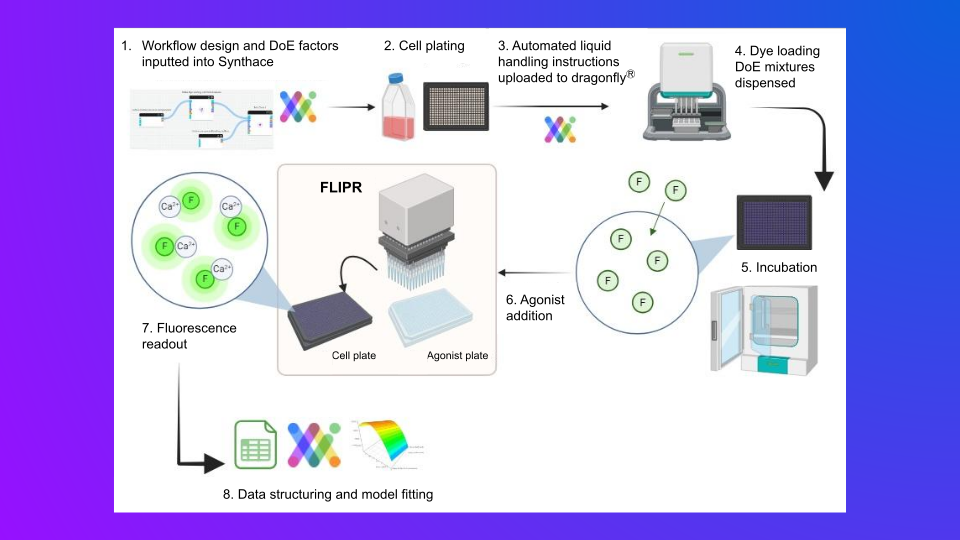
Using Synthace DOE, GSK was able to test multiple factors simultaneously, without the need for advanced coding and statistics knowledge.
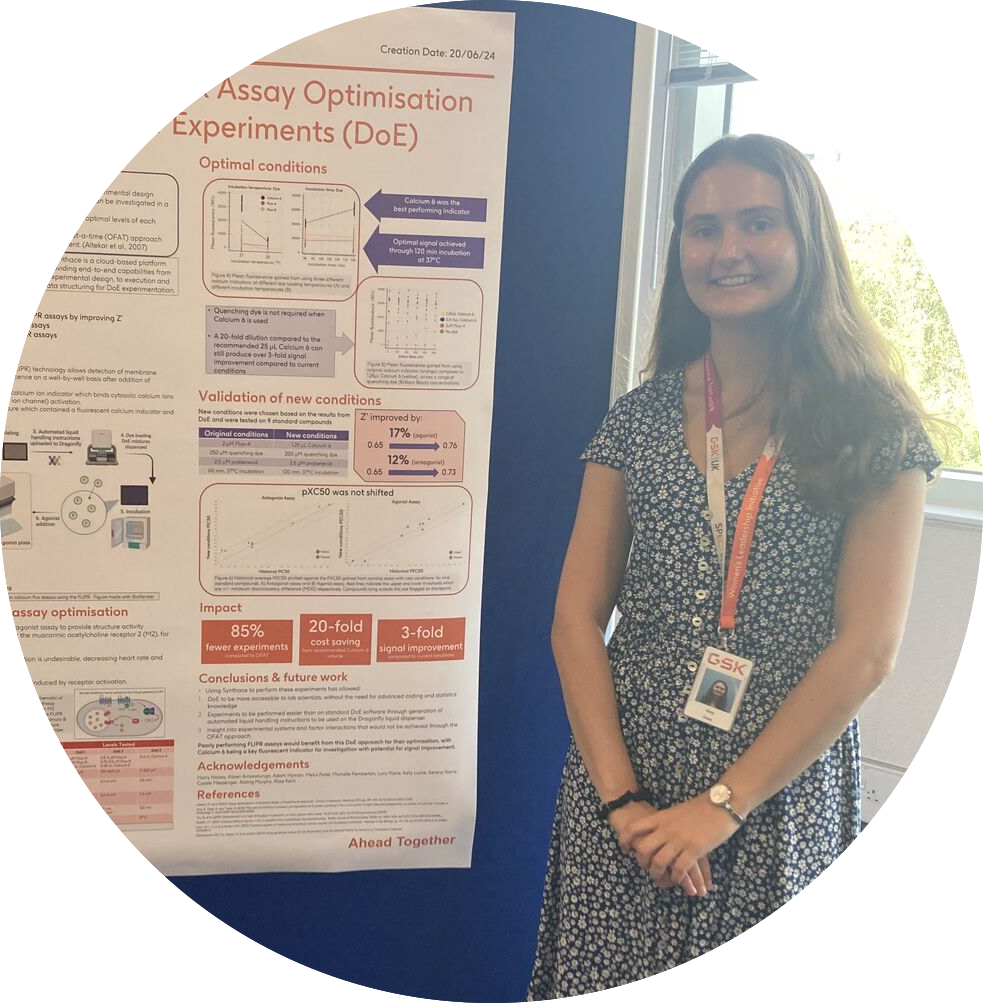
In 3 iterations, they tested 6 DOE factors, including the type and concentration of calcium indicators, incubation time, and temperature.
Synthace generated the device instructions for the SPTLabtech dragonfly® discovery, so experiments were run easily and efficiently.
.svg)
Results
Saving resources, faster optimization, improved performance
Combining GSK's assay knowledge with Synthace's DOE expertise resulted in the development of a cheaper, more sensitive assay in just 3 experiments.
The team identified a calcium indicator that could be used at a 20-fold lower concentration, whilst still producing over 3-fold signal improvement compared to original conditions. Z' was improved by 12% and 17%.
The campaign proved that DOE can improve calcium flux FLIPR assays, opening the door for this approach to be used for similar applications.